

I still remember the energy of the agile team rooms in the early 2000s.
Small team. Sitting together. Writing software in tight iterations, figuring out code, architecture, and design as we went. That’s where I fell in love with building software—not because of the rigid frameworks that later emerged, but because of what the raw methodology unlocked. I owe a massive debt to some very early mentors who showed me these core concepts.
I discovered I didn’t have to write code alone. Pair programming changed everything. I didn’t have to architect the whole system upfront either; I could let the design emerge incrementally. And then came the joy that still stays with me: writing near bug-free software through Test-Driven Development (TDD) and Behavior-Driven Development (BDD). Test-driving your way to working software felt like a superpower.
That energy, that hyper-focused way of working, is what Agile really was at its core.
Fast forward to today: Agentic AI. Autonomous squads. The AI-led Software Development Life Cycle (SDLC). Here is my honest take: The Agile values haven’t changed at all.
- Individuals and interactions over processes and tools.
- Working software over comprehensive documentation.
- Customer collaboration over contract negotiation.
- Responding to change over following a plan.
These still hold. Completely. What has changed completely is the operating model we use to execute them.
The New Abstraction: Code as the New OS
Think about this analogy: we’ve never questioned the abstractions of a modern operating system. We don’t write custom drivers for every application; we just trust the OS layer and build on top of it.
In the pre-GenAI era, we spent enormous energy as engineers writing boilerplate application-layer code and surrounding it with tests to verify we didn’t break things. That was the craft, and it was worth it.
Now? Specialized AI agents write phenomenal application-layer code. That layer is getting abstracted away, just like the assembly language and OS instructions before it.
But here is the critical pivot: we still need to surround agent-generated code with test harnesses. Not because we don’t trust the technology, but because we are shifting from creators to governors. We need to ensure the agents haven’t gone rogue or suffered from context drift. TDD and BDD don’t disappear; they become your primary steering mechanism. The safety net has a new, higher purpose.
Rethinking the Working Model: The Dual-Core Team
This is where we must look beyond just deleting old ceremonies and fundamentally rethink the working model itself.
Agile collaboration was largely designed by humans, for human teams. We wanted people to self-organize, communicate better, build trust, and respond to change together. That remains profoundly important—in fact, high-energy human teams will remain a massive business differentiator.
But when agents enter the squad, the operating model fundamentally bifurcates.
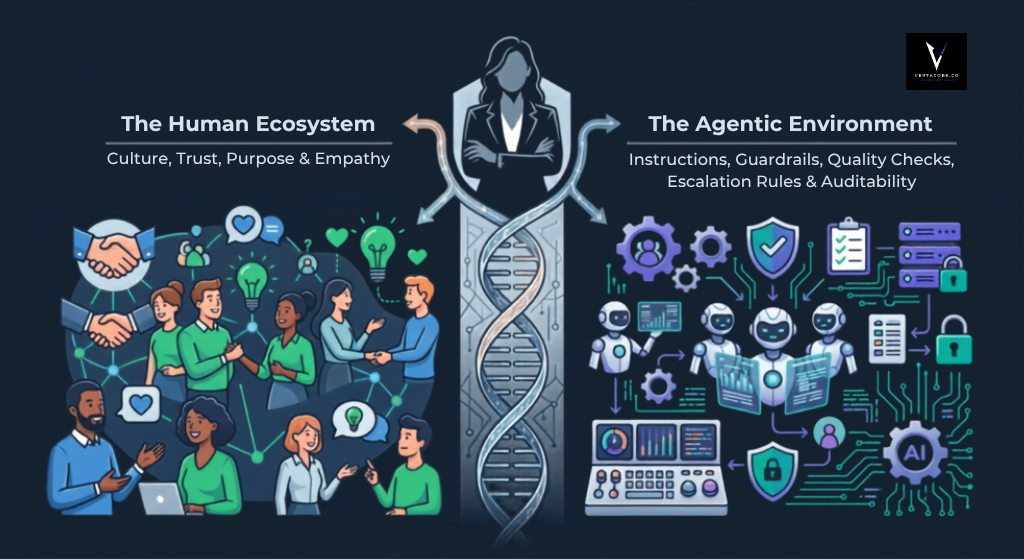
Agents don’t need psychological safety. They don’t need motivation, empathy, or team-building exercises. What they do need is absolute clarity: unambiguous instructions, strict boundaries, explicit permissions, automated quality checks, deterministic escalation rules, and total auditability.
                     ┌────────────────────────────────────────┐
                     │         The Modern Agile Leader        │
                     └───────────────────┬────────────────────┘
                                         │
                    ┌────────────────────┴────────────────────┐
                    ▼                                         ▼
         [ The Human Ecosystem ]                  [ The Agentic Environment ]
    Culture, Trust, Purpose & Empathy         Instructions, Guardrails & Auditability
Consequently, the future Agile leader must master a dual role: they must simultaneously cultivate a creative, self-organized human team and architect a highly controlled, deterministic environment where AI agents can work safely and effectively.
The Shift in the Operating Model
Because agents can synthesize information instantly and operate within these structured environments, the manual coordination overhead designed to keep humans aligned is collapsing.
What is fading fast (The Coordination Overhead):
- Daily standups as status theatre: Agents track progress continuously in the background. Synchronization meetings were always just a workaround for humans lacking real-time visibility.
- Story pointing and velocity obsession: When agents decompose, assign, and execute tasks autonomously, capacity planning based on human estimation loses its meaning.
- Manual backlog grooming sessions: Agents can dynamically reprioritize based on incoming data. The ceremony was always about catching up to a reality that AI now tracks in real-time.
- The Scrum Master as a process enforcer: A lot of that role was change management and Jira ticket hygiene. AI handles the hygiene; human leadership is redirected to organizational outcomes and human dynamics.
- Arguing over syntax and naming conventions: Debating class names, inheritance hierarchies, or folder structures is a solved problem. Stop debating abstractions agents can resolve perfectly in seconds.
What stays and matters more than ever:
- The Agile Values: Unchanged since 2001, and remarkably prescient for the agentic era.
- Test Harnesses & Quality Thinking: TDD/BDD grow in importance; you are now governing agent swarms, not just debugging your own typos.
- Incremental Design: Still the right way to build. Agents amplify it, they don’t replace the need for an emergent, clean architecture.
- Customer Empathy: AI can analyze feedback patterns, but only humans can truly feel the user’s pain point and understand the “why.”
- Strategic Judgment: Deciding what to build, evaluating ethical boundaries, and aligning business strategy remain irreducibly human.
- Psychological Safety and Culture: The early agile rooms had an energy for a reason. Maintaining a culture of trust and shared mission is what allows the human core of the team to drive breakthrough outcomes.
The Reality Check
The dust has far from settled on how our industry will write software. We are yet to fully reckon with the economics of this shift—spending millions of tokens for everything may get prohibitively expensive soon, and generic agents are absolutely not a silver bullet for complex, legacy enterprise systems.
We are in the middle of a technology revolution the likes of which makes the original Agile manifesto look like a minor process update.
But the core intent behind that 2001 manifesto? It survives everything. The teams winning right now aren’t abandoning Agile values. They are shedding the bureaucratic weight designed for human coordination limitations, and doubling down on the engineering craft and collaborative energy that was always the point.
What’s your experience? As a leader, how are you balancing these two opposing worlds—building a high-trust human culture while designing a high-control environment for your agents?
Whether you are designing your own AI-SDLC ecosystem or seeking a strategic partner to operationalize your AI strategy, let’s build the future together. Connect with us at Vertacore.

Leave a Reply